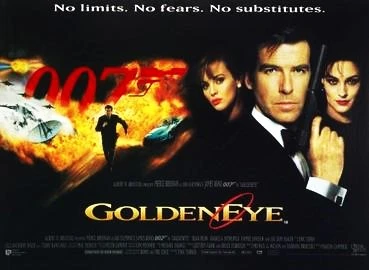
Auric Goldfinger
A gilded criminal mastermind who turns the GoldenEye satellite into his personal throne.

In the games he serves as a high-profile boss encounter, embodying the gilded, ruthless criminal mastermind of the source material. He first appears in the 1997 Nintendo 64 title developed by Rare, where he is one of the major boss fights the player must overcome, and returns in the 2010 Wii sequel. Across both entries he functions as a symbol of the Bond villain archetype: wealthy, theatrical, and dangerous, anchoring the narrative around the GoldenEye satellite and its weaponized potential.
- Role
- Villain / Boss
- Affiliation
- Antagonist (unaffiliated criminal in source material)
- First appears (games)
- GoldenEye 007 (1997, Nintendo 64)
- Status
- Active antagonist in both game entries
- Playable by player
- No (boss encounter only)
Lore & Background
Auric Goldfinger enters the Bond mythos as an international criminal and arms dealer whose ambition is matched only by his theatrical flair. His signature scheme—coating a target in gold dust until it is destroyed—gives him a name that has become synonymous with the Bond villain genre. In the video game adaptations, that same larger-than-life persona is preserved: he is a figure of cold calculation wrapped in opulent presentation, a man who views global infrastructure as a personal playground. In the 1997 Rare-developed N64 title, Goldfinger occupies a position among the game's principal antagonists. The player, controlling James Bond aboard the GoldenEye satellite, must confront him in a dedicated boss arena. His presence signals a late-game escalation, and his encounter is designed to feel like a climactic showdown befitting a character of his stature in the Bond canon. The 2010 Wii continuation carries him forward as a recognizable figure, maintaining his role as a boss-level threat. Across both games he remains a fixed point of the narrative: the man whose name is spoken with a mix of dread and dark amusement, whose gold-tinged silhouette is instantly legible to any player who has encountered a Bond property.
In Their Own Story
The corridor aboard the satellite smells of ozone and cold metal. Bond rounds the last bulkhead and stops. Goldfinger stands at the far end of the chamber, hands clasped behind his back, watching a slow rotation of the Earth through a viewport. He does not turn. "You always were punctual, Mr. Bond." His voice is low, almost conversational, as though they are discussing the weather. Behind him, the GoldenEye array hums to life, its lens catching the sunlight in a blade of white. Goldfinger finally glances over his shoulder, and the expression on his face is not anger. It is the patient smile of a man who has already calculated every move you will make. "Shall we begin?"
Reader's Guide
Auric Goldfinger is a boss-level antagonist in the GoldenEye 007 games. You do not control him; you fight him. In the 1997 N64 title, Goldfinger appears as a late-game boss encounter aboard the GoldenEye satellite. The fight takes place in a dedicated arena where he uses ranged and close-range attacks to pressure you. You will need to watch his tell animations, dodge or sidestep his strikes, and return fire during his recovery windows. He is a large, slow-moving target, but his attack range and the confined arena geometry make him deceptively punishing. In the 2010 Wii entry, his role is similar: a set-piece boss you must defeat to progress. The controls and pacing differ from the N64 original, but the core loop remains—read his pattern, create an opening, land hits, repeat. Tips that carry over from the source material's emphasis on his theatricality: he telegraphs. His wind-ups are long and deliberate. Use that. He is not a speed demon; he is a wall you have to chip away from the edges. Keep your distance when he charges, close in when he recovers, and do not get greedy. One clean hit at a time.
Did You Know?
- In the 1997 N64 game developed by Rare, Goldfinger is positioned as a major boss, reflecting his status as a top-tier Fleming antagonist rather than a minor henchman.
- His signature 'Operation Goldfinger'—gilding a target with gold dust until it is destroyed—is referenced in the games' thematic presentation of him as a wealth-obsessed criminal.
- The GoldenEye 007 franchise spans at least two mainline titles (1997 N64 and 2010 Wii), and Goldfinger appears in both, making him one of the few Fleming villains to recur across the series.
More in Characters
Elsewhere in the GoldenEye universe
Spotted an error? Know more?
This is a living reference — every entry is fact-audited, and reader corrections feed straight into our audit queue. Suggest an edit · See this site's audit record