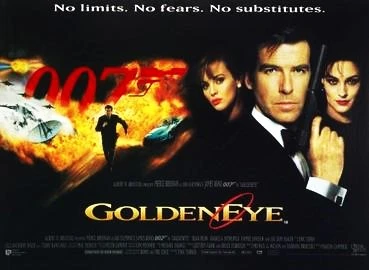
Weapon Pickups
Grab it, aim it, lose it—survival in GoldenEye is one pickup away.

It governs how players acquire, carry, and switch between the arsenal of firearms available in both the single-player campaign and the multiplayer modes. Rather than being permanently bound to a single sidearm, the player (as James Bond or a multiplayer agent) can collect additional weapons from the environment, from fallen opponents, or from fixed stations placed within a level. The system is central to GoldenEye's design philosophy: it creates a constant tension between the weapon you currently hold and the one lying just out of reach, and it gives multiplayer matches a dynamic, shifting arms race as players scramble for the rocket launcher or sniper rifle before their opponent does. Ammo is a separate resource, meaning that picking up a weapon does not guarantee you can use it for long without locating a corresponding magazine.
- Franchise
- GoldenEye 007
- Developer
- Rare
- Publisher
- Nintendo
- First appears
- GoldenEye 007 (N64, 1997)
- Applies to
- Single-player campaign and all multiplayer modes
- Weapon types (N64)
- Pistol, Submachine Gun, Shotgun, Sniper Rifle, Rocket Launcher, Grenade Launcher
Lore & Background
In the world of GoldenEye 007, the player operates as a field agent in a high-stakes conflict involving the satellite weapon known as GoldenEye. The narrative places Bond and his allies in a series of hostile installations—aircraft carriers, missile silos, research facilities—where the enemy is well-armed and the environment is not. The game reflects this by scattering weapons across every corridor and catwalk: a shotgun left by a fallen guard, a sniper rifle mounted on a rooftop, a rocket launcher stashed in a supply crate. The player is expected to scavenge, adapt, and re-engage with whatever is at hand. In multiplayer, the lore extends into a shared arms bazaar. Maps are designed with weapon placement as a tactical element: a rocket launcher might sit in an open courtyard where it is easy to grab but lethal to hold, while a sniper rifle perches on a narrow bridge, rewarding the player who commits to a long-range role. The constant rotation of pickups means no single player can monopolize the most powerful tool for long, keeping matches fluid and unpredictable. The GameCube sequel builds on this foundation with a larger weapon roster and more varied placement contexts—vehicles, destructible cover, and additional map geometry all create new pockets where a weapon might be hidden or exposed. The underlying principle remains: the environment is your armory, and the moment you stop looking, you are outgunned.
In Their Own Story
The corridor smelled of cordite and wet concrete. Bond crouched behind a shattered console, pistol dry, the last shell casing still warm on the floor beside his boot. Across the catwalk, a guard's body slumped against the railing, a submachine gun clutched in one hand and dangling over the abyss below. Twenty metres. A jump. A grab. He could feel the weight of it already in his fingers before he even left cover. The next guard was rounding the corner with a shotgun, and the one behind him was already lifting a rocket launcher onto his shoulder. Bond rolled, snatched the SMG, and fired before the barrel cleared the railing. The world shook. Somewhere ahead, a sniper rifle gleamed on a windowsill, patient as a held breath, waiting for whoever was brave or desperate enough to claim it.
Reader's Guide
Weapon Pickups in GoldenEye 007 work on a simple but layered principle: weapons exist as physical objects in the 3D world, and the player collects them by walking over or into them. In single-player, the campaign script places specific weapons at specific points in each level—often just before a section that demands them, such as a sniper rifle before a long-range engagement or a shotgun before a tight corridor. You pick them up, and they slot into your carry list alongside whatever you already hold. You can switch between carried weapons at any time using the weapon-select input, but you cannot exceed the carry limit the game imposes. Ammo is a separate pickup. Grabbing a rocket launcher does not give you rockets; you must also find a rocket magazine. This means a powerful weapon can be useless if the corresponding ammo is scarce or far away, adding a resource-management layer to every firefight. In multiplayer, weapons are pre-placed around the map and respawn after a set interval if taken. This creates a constant tug-of-war: the rocket launcher in the centre is the most contested object on the map, and whoever holds it while it is loaded has a decisive advantage until it is destroyed or the respawn timer resets. Taking a weapon from a downed opponent is also possible in some modes, adding a reactive element to close-quarters combat. The mechanic matters because it transforms every level from a fixed gunfight into a dynamic negotiation with the environment. You are never simply 'playing with a pistol'; you are constantly deciding whether the weapon three metres to your left is worth the exposure to grab it.
Did You Know?
- In the N64 single-player campaign, weapon placements are scripted to the level design—each level is built around the idea that you will need a specific weapon type at a specific moment, and the pickup is placed just befo
- Picking up a weapon in GoldenEye does not automatically give you its ammo; magazines are separate pickups, so a rocket launcher without rockets is effectively a prop.
- In multiplayer, weapons left on the ground respawn after a set period, meaning the most powerful weapon on a map is always a moving target that shifts between players over the course of a match.
- The GameCube sequel expanded the weapon roster and introduced additional pickup contexts, such as weapons stashed in vehicles or behind destructible cover, making scavenging a more varied part of each encounter.
More in Gameplay & Mechanics
Elsewhere in the GoldenEye universe
Spotted an error? Know more?
This is a living reference — every entry is fact-audited, and reader corrections feed straight into our audit queue. Suggest an edit · See this site's audit record